Le concept de
Bouillie Concentrée Liquéfiée, BCL
Documentation

09A
révision 01/06/2026
Le concept de Bouillie Concentrée Liquéfiée (BCL) se fonde sur l’utilisation d’amylases naturelles pour liquéfier les bouillies. Avant de faire référence à quelques publications sur l’utilisation du malt dans l’Alimentation du Nourrisson et du Jeune Enfant, il faut rappeler les pratiques, réservées à la sphère privée, qui consistent à mêler à la bouillie de l’enfant de la salive maternelle ou du lait maternel, pour la liquéfier. |
1. L’usage traditionnel des amylases naturelles.
L’usage d’amylases maternelles, en particulier de salive pour liquéfier et améliorer la digestion des bouillies est universel :
1975, JAKEZ HELIAS P., Le cheval d’orgueil, Edition PLON Terre Humaine Poche 1975 pages 55 : « Tout le monde sait que la salive maternelle aide l’enfant à digérer la bouillie de blé ».
D’autres textes comme celui de cet auteur breton peuvent être cités
2000, ROLLET C, MOREL MF, Des bébés et des hommes MF Albin Michel 2000 pp 114-116. « En France, on sait […] que les mères font cuire la bouillie dans un petit poêlon, placé dans un coin de la cheminée; une fois cuite, elle passe d’abord dans la bouche de la mère puis est donnée au nourrisson avec une cuillère ou sur le doigt. Cette manière de faire a longtemps été critiquée par les médecins, à partir du XVIIIe siècle, comme contraire à l’hygiène. En réalité, la bouillie imprégnée de sucs salivaires de la mère est prédigérée et donc beaucoup plus facilement assimilable par le bébé […]. On retrouve cette même pratique en Annam où la mère mastique le riz dans sa bouche avant de le donner au bébé ». […] Beaucoup de nourrissons gavés de bouillies indigestes ont le ventre gonflé et dur et ne grossissent pas »..
Ou encore :
BREUKEL MICHEL J. « La salive est riche en ptyaline, ce qui permet une prédigestion intéressante de l’aliment. A cet effet, plus tard il m’est souvent arrivé de prémâcher une amande pour la rajouter à une bouillie, ce qui avait pour effet de pré-digérer toute la bouillie.».
L’utilisation d’amylases naturelles, sous forme de céréales germées (maltage) est aussi connue pour la préparation de bières, sous presque toutes les latitudes. L’amidon du grain malté est ainsi transformé en sucres solubles fermentescibles. Cependant, Claude LEVI-STRAUSS rapporte une autre technique amérindienne pour préparer de la bière. La bouillie de maïs est additionnée de salive de jeunes filles pour permettre sa fermentation.
1955 LEVI-STRAUSS C - Tristes Tropiques, PLON Terre humaines / Poche. page 417.
L’usage du lait maternel comme moyen d’améliorer la digestion de l’amidon est peu documenté.
1992 DIWIT O, DESJEUX J.F. « Digestion de l'amidon chez l'enfant sain, l'enfant atteint de mucoviscidose, et chez le nourrisson allaité au sein, mesurée à l'aide d'un test respiratoire au carbone 13 »
2. A propos de l’importance de l’amylase pour la digestion de l’amidon
2.1. Le rôle de l’amylase salivaire et pancréatique
2.2. La pleine maturité de la fonction amylasique demande quelques années.
2.3. Le gain d’absorption des hydrates de carbone après liquéfaction amylasique des bouillies est documenté par une approche de laboratoire, en 1995.
2.4. La corrélation entre déficit amylasique et malnutrition est décrite dès 1973.
3. Les farines infantiles maltées ou diastasées.
3.1. L’utilisation de céréales maltées est proposée dès les années 1940
3.2. Le phénomène de Dietary Bulk
3.3. L’intérêt du maltage
3.4. Corrélation consommation énergétique et viscosité
4. L’ajout de malt aux bouillies
4.1. Utilisation de malt pur dans pharmacopée française
4.2. Le malt ajouté à la bouillie porte différent nom
5. Le Projet BAMiSA et les amylases naturelles
Le projet BAMiSA s’inscrit dans cette démarche de liquéfaction des bouillies
épaisses dès les années 1990.
Note à propose des amylases industrielles
BIBLIOGRAPHIE
2. A propos de l’importance de l’amylase pour la digestion de l’amidon
Comme on l’a vu, il est connu traditionnellement que l’amylase salivaire maternelle permet de suppléer au déficit du nourrisson en amylase. L’étude scientifique de la fonction amylasique salivaire et pancréatique du nourrisson et du jeune enfant est plus tardive.
2.1. -.L’industrie des ‘’Préparations pour nourrissons’’ (laits infantiles) prend en compte le déficit en amylase pancréatique des jeunes enfants dans les formules de laits anti-régurgitation :
1980 SENTERRE J - Net absorption of starch in low birth weight infants. Acta Paediatrica Scand 1980 ; 69 : 653-7. DOI: 10.1111/j.1651-2227.1980.tb07338.x
Abstract : Twelve 3-day metabolic balance studies were carried out in 12 low birth weight infants fed an infant formula providing 3.5 g of corn starch per kilogram body weight per day. The mean coefficients of net absorption were 88 +/- 6% for starch, 70 +/- 14% for fat and 90 +/- 4% for nitrogen. No relationship was found between starch absorption and nitrogen or fat absorption. There was no relationship between starch absorption and the duration of starch feeding. It is concluded that the ability of young infants to digest large quantities of starch is most likely limited resulting from low pancreatic alpha-amylase activity. Nevertheless, from a practical point of view, small amounts of starch in infant formulas can be considered not only as a thickener but also as a source of calories.
2.2. – La pleine maturité de la fonction amylasique n’est acquise par les enfants qu’après plusieurs années.
1984 SEVENHUYSEN GP, HOLODINSKY C, DAWES C - Development of salivary alpha-amylase in infants from birth to 5 months.Am J Clin Nutr. 1984 Apr; 39(4):584-8. DOI: 10.1093/ajcn/39.4.584
Abstract : The alpha-amylase activity in whole saliva of two groups of infants was investigated from birth to 5 months at monthly intervals. Foods used in infant feeding as well as height and weight were recorded at each monthly collection period. alpha-amylase activity was found to increase rapidly from low values at birth to approximately two-thirds of adult values by 3 months. Large variation in alpha-amylase activity, either per ml of saliva or per mg of protein, was recorded. No significant relationships of alpha-amylase activity with weight, weight for height, growth rate, or presence of starch-containing foods in the diet were found. Introduction of starch-containing food before 3 months of age would likely lead to inadequate hydrolization of starch in some infants.
1986 NAVARRO J SCHMITZ J. - Développement des fonctions de digestion et d'absorption - Digestion et absorption des sucres. Gastro Entérologie Pédiatrique, Flammarion, 1ère et 2nd édition 2000
Extrait : L’activité de l’α-amylase pancréatique pratiquement nulle à la naissance, demeure extrêmement faible au cours des premières semaines. Elle s’élève ensuite lentement mais reste très inférieure (3 à 4 fois) encore à l’âge de six mois à celle des enfants plus âgés et n’atteint qu’après trois ans les valeurs de l’adulte.
1999 CHRISTIAN M , EDWARDS C, WEAVER L T, LAWRENCE T - Starch digestion in infancy. J Pediatr Gastroenterol Nutr : August 1999 - Volume 29 - Issue 2 - p 116-124 DOI: 10.1097/00005176-199908000 -00004
Abstract : Salivary amylase is detectable from 20 weeks’gestation. Its activity increases rapidly after birth to reach near adult levels from 6 months to 1year, but there is large interindividual variation…Serum concentrations (of pancreatic amylase) at birth are 1.6% of adult levels and do not reach mature levels until 5 to 12 years.
2018 SHULMAN Robert J. _ Starch Malabsorption in Infants. Journal of Pediatric Gastroenterology and Nutrition: June 2018 - Volume 66 - Issue - p S65-S67 doi: 10.1097/MPG.0000000000001856
Summary : Recommendations are underscored for the timing of the introduction of complementary cereal feeding, not only by recognizing the physical ability of the infant to swallow solids, and the possibility of allergy issues, but also by the limited starch digestive capacity of the young infant. The studies reviewed emphasize the great variability among infants in the rate at which pancreatic amylase function develops, and, therefore, the ability of infants to digest starch. One must also consider the potential of cereal feeding to cause poor weight gain and/or diarrhea. Conversely, evidence exists suggesting that the feeding of starch can enhance pancreatic amylase activity.
2.3 – Le gain d’absorption des hydrates de carbone après liquéfaction amylasique des bouillies est confirmé par une approche de laboratoire.
1995 WEAVER LT, DIBBA B, SONKO B, BOHANE TD, HOARE S - Measurement of starch digestion of naturally 13C-enriched weaning foods, before and after partial digestion with amylase-rich flour, using a 13C breath test.. Br J Nutr.1995 Oct 74(4) : 531-7. DOI: 10.1079/bjn19950156
Abstract ::Percentage dose of 13C recovered increased from a mean 13.7 (SD 3.7)% before, to 18.3 (SD 5.6)% after ingestion of amylase-treated weaning foods (P < 0.1). There was a significant inverse relation between age and weight, and percentage dose of 13C recovered in children receiving amylase-treated feeds. There were no differences in concentrations of amylase in saliva of infants or breast milk of their mothers. Partial digestion of supplementary foods may improve the nutrition of undernourished weaning children, not only by reducing their viscosity, thereby increasing ingestion, but also by improving their digestion and thereby their absorption.
2.4. La corrélation entre retard de croissance (poids et taille), et déficit en amylase pancréatique a été décrite en 1973. L’aggravation du déficit amylasique par certaines malnutritions est aussi documentée en 1977. Cette corrélation ne dit pas si le déficit amylasique est responsable de malnutrition ou si c’est la malnutrition qui fait perdurer le déficit amylasique.
1973 LILIBRIDGE C.B., TOWNES P.L. - Physiologic deficiency of pancreatic amylase in infancy : a factor in iatrogenic diarrhea. J.pediatr.,82:279-282 (1973) DOI: 10.1016/s0022-3476(73)80167-2 https://pubmed.ncbi.nlm.nih.gov/4684370
Résumé : La suppression, au cinquième mois, de l’amidon de riz donné dès la première semaine de vie à dose croissante, a mis fin à la diarrhée et a permis la reprise de poids et de taille.
1977 WATSON RR, TYE JG, MCMURRAY DN, REYES MA – Pancreatic and salivary amylase activity in indernourished Colombian children. The American Journal of Clinical Nutrition, 01 Apr 1977, 30(4):599-604 DOI: 10.1093/ajcn/30.4.599
Abstract Amylase activities were quantitated in secretions of marginally and severely malnourished Colombian children. In young children with a mean age of 21 months, the relative pancreatic and salivary amylase isozyme activities of urine were significantly changed in marginally malnourished children compared to normal children. There was a relative increase in salivary and decrease in pancreatic amylase activity in the undernourished children and total amylase activity was somewhat decreased. Amylase activity in saliva and tears was significantly lower in these malnourished children. Older children who were more severely malnourished had significantly lower amylase activity in their sera and tears. Thus marginal and severe malnutrition affects the production of amylase by the pancreas and salivary glands of young children distinctly. It significantly suppresses amylase activity in tears, saliva, and serum.
Résumé Les activités amylasiques ont été quantifiées dans les sécrétions d'enfants colombiens modérément et sévèrement malnutris. Chez les jeunes enfants d'une moyenne d'âge de 21 mois, les activités relatives des isoenzymes amylasiques pancréatiques et salivaires dans les urines ont été significativement changées comme le montre la comparaison entre enfants modérément et sévèrement malnutris. Il y a un relatif accroissement de l'activité amylasique salivaire et un une diminution de l'activité amylasique pancréatique chez les enfants malnutris, et une légère diminution de l'activité amylasique totale. L'activité amylasique salivaire et des larmes était significativement plus basse chez ces enfants malnutris. Les enfants plus âgés qui étaient plus sévèrement malnutris avaient une activité amylasique plus basse dans leur sérum et dans leurs larmes. Ainsi, la malnutrition modérée et sévère affecte significativement la production d'amylase par le pancréas et les glandes salivaires des jeunes enfants. Elle diminue l'activité amylasique des larmes, de la salive et du sérum.
1989 PRENTICE A., DEWIT 0. DIBBA B. JARJOU L. - Amylase salivaire chez l'enfant dont l'état nutritionnel est marginale et place de l'amylase du lait de mère. Medical research Council DUNN Nutrition Unit, Cambridge, Royaume Uni et Kenaba, Gambie.
Nutrition Clinique et Métabolisme Volume 3, Issue 4, 1989, Page 236 DOI: 10.1016/s0985-0562(89)80053-6
Extrait : La production des amylases salivaire et pancréatique est faible chez le nouveau-né, et n’atteint le niveau adulte qu’après l’âge de 1 à 2 ans chez l’enfant sain. …Les valeurs observées chez les enfants ayant un rapport poids/âge inférieur à 80% étaient seulement 40% de celles des enfants ayant un rapport poids/âge supérieur ou égal à 100% (p<0,01)…Après l’âge de 3 mois, le niveau d’activité amylase dans la salive des enfants gambiens était inférieur à la moitié de celui des enfants de Cambridge (p<0,01).
3. Les farines infantiles maltées ou diastasées dans la diététique médicale.
3.1. L’utilisation de céréales maltées (germées) évite que les bouillies n’épaississent et améliore leur digestibilité. Les farines infantiles maltées commerciales font leur apparition au cours de la deuxième guerre mondiale.
Comme le mentionne la notice ci-dessous, les farines maltées « suppléent à l’insuffisance digestive naturelle » du nourrisson.
1942 Publicité pour les farines maltées JAMMET.
Fac-similé du « Carnet de pesées » édité par la marque SALUS et SCIENCIA
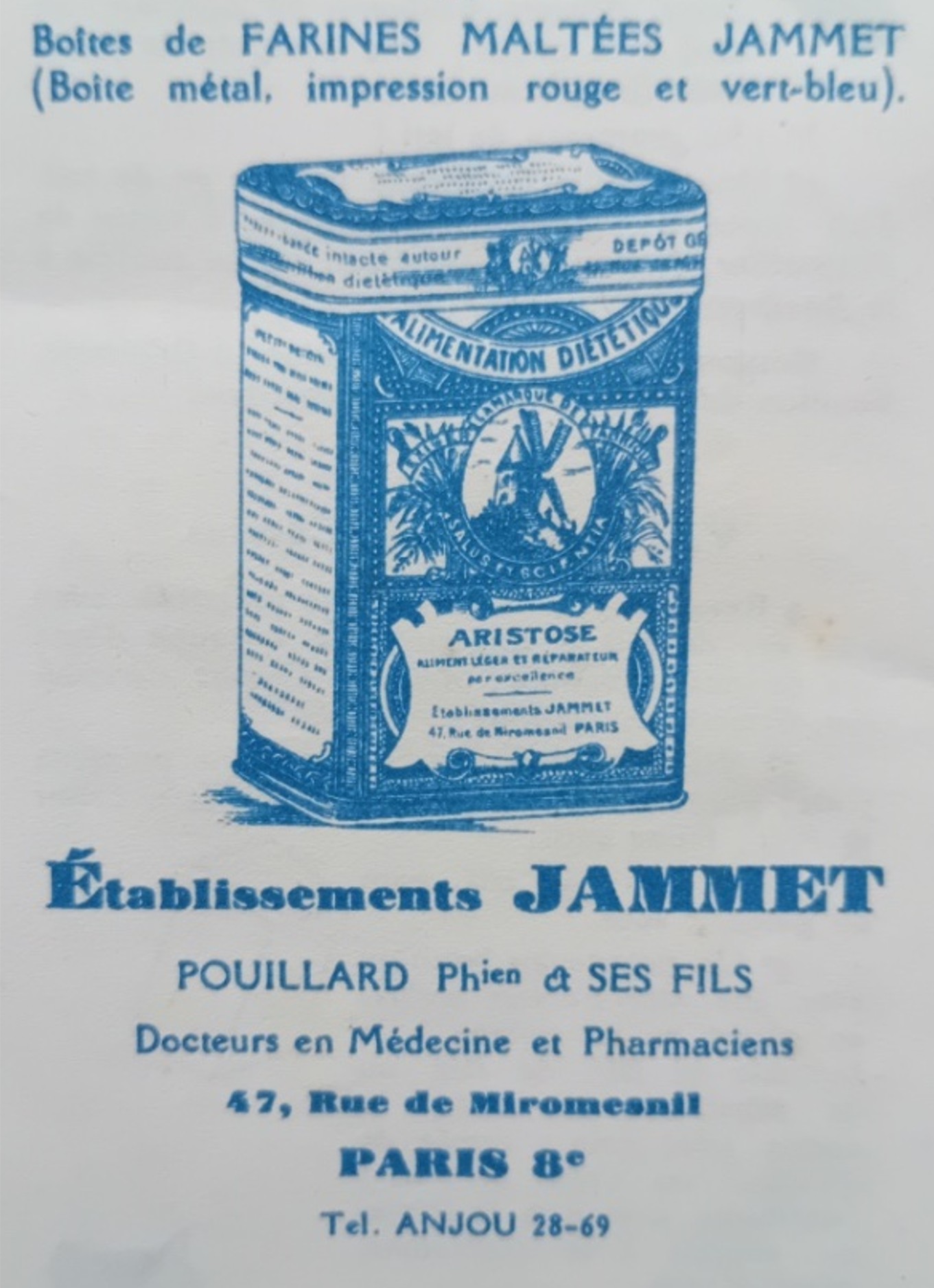
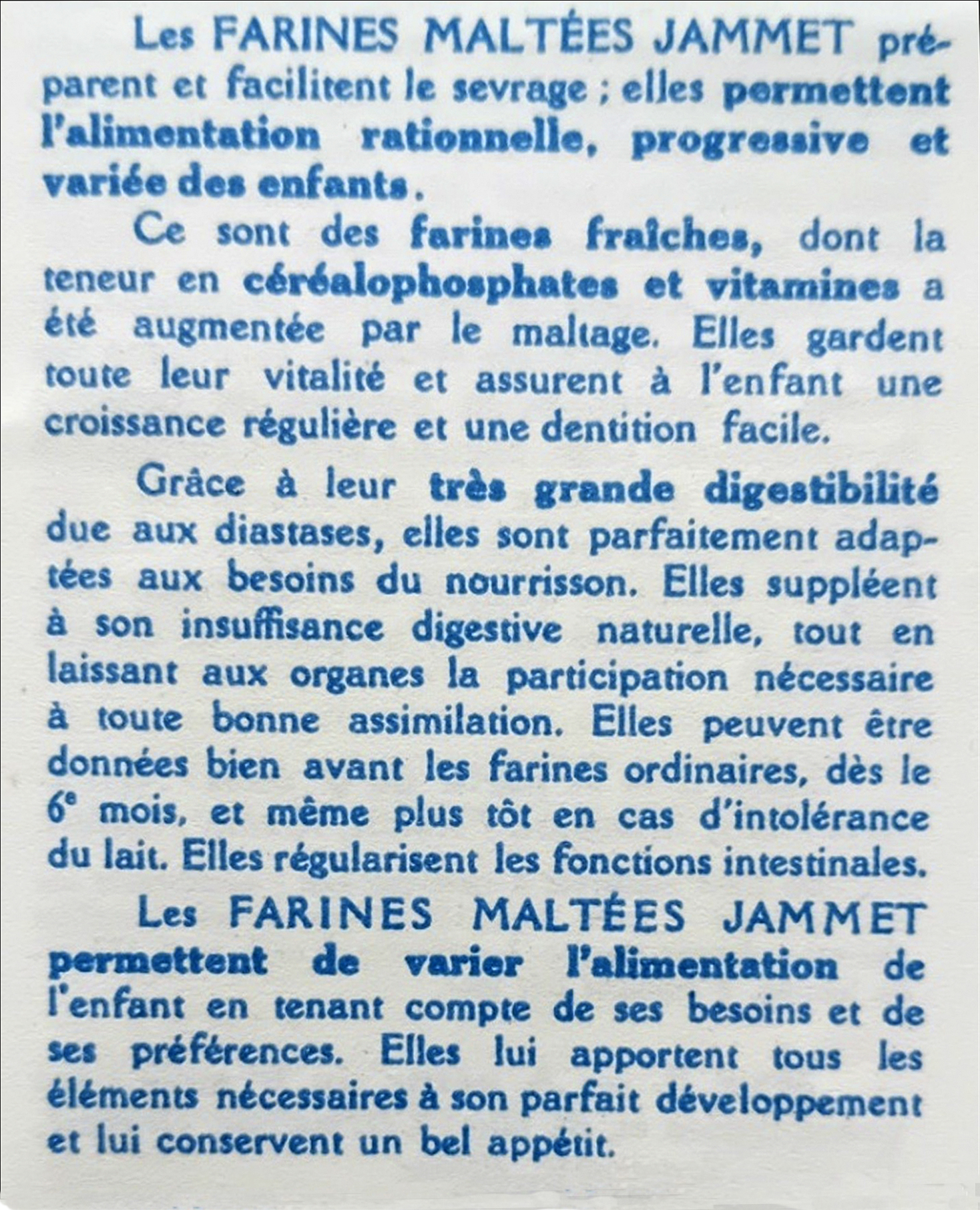
L’utilisation de farines maltées est inscrite dans la diététique du nourrisson.
1963 PIN P, La médecine familiale moderne, Edition Boutan-Marguin “
“Les premières bouillies exigent une farine maltée”. p 510
A noter que les bouillies préparées avec du lait et des farines maltées ont été accusées de faire trop grossir les jeunes enfants !
3.2. - La viscosité élevée des bouillies limite l’apport en nutriments, soit parce qu’elles vont être diluées, soit parce qu’elles ne seront pas entièrement consommées, soit parce qu’elles seront mal digérées. Le phénomène de ‘’Dietary Bulk’’ désigne l’effet dit ‘’bourratif’’ ou ‘’de gros volume’’ ou ‘’d’encombrement’’ des bouillies ou encore de ‘’gros ventre’’. Il est reconnu comme une des causes de malnutrition.
1981 « Dietary bulk as a limiting factor for nutrient intake ».
BJÖRN G. LJUNGQVIST, OLOF MELLANDER, ULF S. O. SVANBERG - Dietary bulk as a limiting factor for nutrient intake in pre-school children : I. A problem description.
Journal of Tropical Pediatrics. Volume 27, Issue 2, April 1981, Pages 68–73, https://doi.org/10.1093/tropej/27.2.68
ÅKE HELLSTRÖM, ANN-MARIE HERMANSSON, ANNE KARLSSON, BJÖRN LJUNGQVIST, OLOF MELLANDER, ULF SVANBERG - Dietary Bulk as a Limiting Factor for Nutrient Intake—with Special Reference to the Feeding of Pre-School Children : II. Consistency as related to dietary bulk. A model study.
Journal of Tropical Pediatrics, Volume 27, Issue 3, June 1981, Pages 127–135, https://doi.org/10.1093/tropej/27.3.127
BRITA BRANDTZAEG, N. G. MALLESHI, U. SVANBERG, H. S. B. DESIKACHAR, O. MELLANDER - Dietary Bulk as a Limiting Factor for Nutrient Intake—with Special Reference to the Feeding of Pre-School Children : III. Studies of malted flour from ragi, sorghum and green gram.
Journal of Tropical Pediatrics, Volume 27, Issue 4, August 1981, Pages 184–189, https://doi.org/10.1093/tropej/27.4.184-a
ANNE KARLSSON, ULF SVANBERG - Dietary Bulk as a Limiting Factor for Nutrient Intake in Pre-School Children : IV. Effect of digestive enzymes on the viscosity of starch-based weaning foods
Journal of Tropical Pediatrics, Volume 28, Issue 5, October 1982, Pages 230–234, https://doi.org/10.1093/tropej/28.5.230
3.3. - L’intérêt du maltage comme moyen permettant de diminuer la viscosité des bouillies épaisses fait l’objet de plusieurs publications.
1957 CHANDRASEKHARA MR, Swaminathan, M., Sankaran, A. N., Subrahmanyan, V. - Studies on nutritive value of balanced malt foods. Indian Journal of Physiology and Allied Sciences 11,27 1957, Bulletin of Central Food Technological Research Institute, 6. pp. 1-3.
Pas d’abstract disponible en ligne
1979 BRANDTZAEG B and coll. - Nutritional and technological evaluation of malted flours from ragi, sorgum and green gram for local processing of supplementary and weaning foods. Report to the World Hunger Programme, Université des Nation Unies Tokyo Japon, 1979]
Ce travail étudie les farines maltées d'éleusine, de sorgho et de mungo.
1980 DESIKACHAR HSR. - Development of weaning food with high calorie density and low hot-past viscosity using traditional technologies. Food and Nutrition Bulletin vol 2 N°4,p 21 - 23, 1980
https://www.semanticscholar.org/paper/Development-of-weaning-foods-with-high-caloric-and-Desikachar/ecd7ff07a00ebf496f12ab31d5f293ce7fcdeebc
Abstract : Effects of malting and of traditional heat-processing operations (toasting, sand roasting, parboiling, steaming under pressure, flaking) on paste viscosity of commonly used cereals, millets and a legume were studied. Results showed that heat treatment reduced hot-paste viscosity. Gelatinization of starch during heating increased cold-paste viscosity. Max. reduction in hot-paste (slurry) viscosity was achieved by cooking under pressure, or puffing for 1-2 min at 200-250 degree C. Max. reduction in both hot- and cold-paste viscosity was achieved by malting. A basic weaning-food mix was formulated, using ragi (finger millet, Eleusine coracana) and green gram (Phaseolus radiatus). The components were germinated for 24-48 h, dried, and the vegetative portion removed by gentle abrasion. The materials were kilned by toasting to 70 degree C and the bran removed. The malted flours were mixed in a ratio of 2 cereal flour:1 legume flour, and the basic weaning mix was fortified with synthetic vitamins. The malted weaning food had much lower viscosity (higher caloric density) than conventional roller-dried weaning food. It was well tolerated by 1-31/2 yr old children in feeding studies. Its advantages over commercial products are low bulk (higher caloric density), better digestibility, lower cost and simple technology.
1982. GOPALDAS T - Malted versus roasted weaning mixes : development, storage, acceptability, and growth trial, Université des Nations Unies Tokyo Japon p 283-305, 1982
Cette étude compare les "mélanges pour sevrage" maltés et grillés.
1984 MOSHA A, - The Luganga village study: acceptance and intake of bulk-reduced weaning porridge. Tanzanian Food and Nutrition Center Dar es Salaam, Tanzanie,
Résumé, de SEENAPPA M, in Actes de l’atelier UNICEF/SIDA/CRDI ‘’Pour améliorer l’alimentation des jeunes enfants en Afrique orientale et australe’’, Nairobi, p 44.
L’utilisation de 5% seulement de farine de malt (venant de l’éleusine) s’est avérée simple et efficace pour réduire la viscosité ; de plus, si on ajoute deux fois la quantité normale de farine, cette technique aura pour effet d’augmenter la densité calorique des aliments. Les campagnes de nutrition, notamment celles menées en Tanzanie, ont donné de bonnes occasions de faire valoir la « farine énergétique » ou « kiméa ».
1987 SVANBERG U S , FREDICKZON B , GEBRE-HIWOT B , TADDESSE W W. - Sorghum in a mixed diet for preschool children. I. Good acceptability with and without simple reduction of dietary bulk
J Trop Pediatr 1987 Aug;33(4):181-5. DOI: 10.1093/tropej/33.4.181
https://pubmed.ncbi.nlm.nih.gov/3669133/
Abstract The palatability and acceptability of sorghum based Faffa was evaluated in Ethiopian children aged 2–5 years. The Faffa was offered in sufficient amounts to make a significant contribution to the dietary intake of the children. The sorghum based Faffa was well accepted when offered as porridge, bread or pancake mixed with the traditional Ethiopian diet so as to contribute about 50 per cent of the daily protein intake. Bulk reduced Faffa porridge was prepared by adding porridge made from germinated (malted) sorghum to ordinary Faffa porridge. The bulk reduced porridge contained 25 per cent more Faffa flour compared to ordinary porridge though of similar consistency. However the mean daily intake of solid food was less in bulk-reduced Faffa (758 g) compared to ordinary Faffa (839 g) resulting in about the same average daily energy intake. This finding suggests that the children were able to adjust their energy intake by modifying their food intake
1987 SVANBERG U - Le gros volume alimentaire des produits de sevrage et son effet sur l'apport énergétique et nutritionnel. In "Pour améliorer l'alimentation des jeunes enfants en Afrique orientale et australe", UNICEF/SIDA/CRDI, Compte rendu d'un atelier tenu à Nairobi, Kenya du 12 au 16 octobre 1987.pp 310-324
1987 1980 DESIKACHAR HSR. Les aliments de sevrage au Népal Yogesh Vaidya, Atelier Nairobi Kenya Actes 1987 UNICEF-SIDA
Comme l’étude de GOPALDAS en 1982, cette étude démontre que les multimélanges maltés, prêts pour la consommation, offraient des avantages considérables par rapport aux mélanges rôtis (grillés).
1987 MOSHA AC et coll - Les produits de sevrage à forte teneur nutritive faits de céréales germées. In "Pour améliorer l'alimentation des jeunes enfants en Afrique orientale et australe", UNICEF/SIDA/CRDI, Compte rendu d'un atelier tenu à Nairobi, Kenya du 12 au 16 octobre 1987. pp 332-339
1991 CODEX ALIMENTARIUS GUIDELINES ON FORMULATED SUPPLEMENTARY FOODS FOR OLDER INFANTS AND YOUNG CHILDREN, CAC/GL 08-1991
5.4 Sprouting and Malting
5.4.1 Cereals and pulses can be induced to germinate by soaking or humidifying. It is necessary, however, to ensure that growth of mycotoxin producing microorganisms does not occur. The action of natural amylases contained in the grains results in the predigestion of the starchy portion of the grain (dextrinization) thus reducing the bulk of the food when prepared for feeding and, ultimately, increasing the nutrient density of the food.
1994 STEPHENSON D M , GARDNER J M , WALKER S P , ASHWORTH A - Weaning-food viscosity and energy density: their effects on ad libitum consumption and energy intakes in Jamaican children. The American Journal of Clinical Nutrition, Volume 60, Issue 4, October 1994, Pages 465–469, https://doi.org/10.1093/ajcn/60.4.465
Summary : The effects of weaning-food viscosity and energy density on consumption and energy intake were determined in 15 non-breast-fed Jamaican children aged 7-15 mo under standardized conditions and amylase treatment to reduce viscosities offered any advantage.
Abstract
The effects of weaning-food viscosity and energy density on consumption and energy intake were determined in 15 non-breast-fed Jamaican children aged 7-15 mo under standardized conditions. We tested whether feeding thick, energy-dense porridge four times daily resulted in increased energy intakes and whether amylase treatment to reduce viscosity offered any advantage. When a traditional liquid, low-density porridge (2.15 kJ/g) was fed, the mean (+/- SD) daily consumption was 139 +/- 25 g/kg and the mean daily energy intake was 296 +/- 54 kJ/kg. When a semisolid
high-density porridge (4.09 kJ/g) was fed, consumption was significantly lower (98 +/- 21 g/kg) but the daily energy intake was significantly higher--402 +/- 85 kJ/kg (P < 0.001). Amylase treatment of the thick energy-dense porridge did not increase intakes further. Meal duration for the thick porridge (12.9 +/- 4.0 min) was significantly longer than that for the low-density (7.4 +/- 2.6 min) or amylase-treated (6.4 +/- 1.8 min) porridges.
2011 ZANNOU-TCHOCHO V., AHUI-BITTY L., KOUAME K., KOUAME G, DALLY T. - Utilisation de la farine de maïs germé source d’α-amylases pour augmenter la densité énergétique de bouillies de sevrage à base de manioc et son dérivé l’attiéké, Journal of Applied Biosciences, 37. 2477-2484. 2011.
https://www.yumpu.com/fr/document/view/17336870/utilisation-de-la-farine-de-mais-germe-source-dalpha-elewaorg/2
Méthodologie et résultats : La méthode utilisée consiste à étudier l’effet de l’incorporation de la farine de maïs germé sur les bouillies en fonction de leur teneur en matière sèche. Les résultats obtenus (30% de matière sèche et 120 Kcal/100ml de bouillies) en ce qui concerne les bouillies classiques de manioc + soja et d’attiéké +soja montrent que les plus faibles doses de farine de maïs germé utilisé (5% et 10%) ont permis d’obtenir des résultats conformes aux normes recommandées par l’OMS, relatives aux bouillies de complément destinées aux enfants en âge de sevrage.
3.4. - Une corrélation est établie entre faible consommation énergétique et viscosité élevée.
1994 VERSTER A (OMS Senior Advisor)°- L'expérience tanzanienne in ‘’L'alimentation de complément du jeune enfant’’ : Actes d'un atelier OMS/ORSTOM, du 20 au 24 Novembre 1994 à l'Université Senghor Alexandrie (Egypte). pp 334-337.
https://www.decitre.fr/livres/l-alimentation-de-complement-du-jeune-enfant-9782709912891.htm
Cette intervention reprend les études relatives à l’usage de malt dans les bouillies et ajoute « Il se pourrait bien que ce soit dans la réduction du temps nécessaire pour nourrir l’enfant qu’on trouve la raison d’être principale [des bouillies liquéfiées] »
The American Journal of Clinical Nutrition, Volume 70, Issue 2, August 1999, Pages 285–291, https://doi.org/10.1093/ajcn.70.2.285
Amylase liquefaction of HD-HV porridges resulted in increased energy consumption by young children, and energy consumption from the HD-LV diet was greater than from the other diets and the energy intakes from the latter diets were not significantly different.
Abstract : Results of prior studies of the effect of viscosity reduction of high-energy-density, starch-containing diets on young children's energy intakes are inconsistent, possibly because of differences in the characteristics of the unmodified diets with which the low-viscosity diets were compared. OBJECTIVE. Our objective was to determine the effects of dietary viscosity and energy density on total daily energy consumption by young, non-breast-fed children. DESIGN We measured the amount of food consumed and the duration of meals during 3 substudies, in each of which 3 study diets were offered for 4 consecutive days each in random sequence: high energy density, high viscosity (HD-HV); high energy density, low viscosity (HD-LV); and low energy density, low viscosity (LD-LV). The viscosity and energy density of the unmodified starch-containing HD-HV diet were varied across substudies to determine whether the effect of amylase liquefaction was related to the initial characteristics of the HD-HV diet. The viscosity of the HV diets ranged from 79000 to 568000 mPa s; energy density of the HD diets ranged from approximately 4.18 to 4.93 kJ (1.00-1.18 kcal)/g. Viscosity of the LV diets was approximately 3000 mPa s and the energy density of the LD diets was approximately 2.47 kJ (0.6 kcal)/g. RESULTS In each substudy, children consumed more of the LD-LV diet (g kg body wt(-)(1) d(-)(1)) than of the other diets and more of the HD-LV diet than of the HD-HV diet (P < 0.001). Energy consumption from the HD-LV diet was greater than from the other diets (P < 0.001), but the energy intakes from the latter diets were not significantly different. CONCLUSION Amylase liquefaction of HD-HV porridges resulted in increased energy consumption by young children.
2011 ZANNOU-TCHOCHO V., AHUI-BITTY L., KOUAME K., KOUAME G, DALLY T. - Utilisation de la farine de maïs germé source d’α-amylases pour augmenter la densité énergétique de bouillies de sevrage à base de manioc et son dérivé l’attiéké, Journal of Applied Biosciences, 37. 2477-2484. 2011.
https://www.yumpu.com/fr/document/view/17336870/utilisation-de-la-farine-de-mais-germe-source-dalpha-elewaorg/2
Méthodologie et résultats : La méthode utilisée consiste à étudier l’effet de l’incorporation de la farine de maïs germé sur les bouillies en fonction de leur teneur en matière sèche. Les résultats obtenus (30% de matière sèche et 120 Kcal/100ml de bouillies) en ce qui concerne les bouillies classiques de manioc + soja et d’attiéké +soja montrent que les plus faibles doses de farine de maïs germé utilisé (5% et 10%) ont permis d’obtenir des résultats conformes aux normes recommandées par l’OMS, relatives aux bouillies de complément destinées aux enfants en âge de sevrage.
4 – L’ajout de malt à la bouillie
L’ajout d’amylase à la bouillie (et non à la farine) est moins documenté. Cependant cette pratique a fait partie de la pharmacopée française :
4.1. - L’utilisation de malt ‘’pur’’ pour liquéfier les bouillies ’
1966 BLONDET P - Soins à donner aux enfants, préface Robert DEBRÉ, Edition Lamarre-Poinat, Page 212.
Extrait : Après avoir préparé une bouillie comme à l’ordinaire, la retirer du feu pendant 3 minutes ; à ce moment, ajouter une cuillerée de malt (Maltogil®, Maltea Moser®). https://marques.expert/diepal/maltogil-1336627.html
4.2. A partir de 1983, cette pratique est étudiée en Afrique et en Inde. L’ajout de malt en petite quantité à farine, mais surtout à la bouillie destinée aux jeunes enfants est étudié par une équipe en Tanzanie autour de MOSHA. En 1987, une équipe en Inde autour de GOPALDAS confirme ces études. Dans ces publications, le malt ajouté à la bouillie est désigné par ‘’Germinated Flour’’, ‘’Germinated enzyme-rich flour”, "Flour of germinated céreals ", ‘’Power Flour’’, ‘’Farine Energétique’ (FE), Kiméa”, Amylase Rich Flour (ARF), Aliment Riche en Amylase (ARA), Farine riche en amylases (FRA).
1983 MOSHA A.C., SVANBERG U. Tanzania Food and nutrition center, University of Göteborg - Preparation of weaning foods with high nutrient density using flour of germinated cereals. UNU Food and Nutrition Bulletin 5(2),10-14, 1983 /unupress/food/8F052e/8F052E03.htm
CONCLUDING REMARKS : The viscosity-reducing effect of using germinated cereals for preparing gruels intended for infants and small children has been reported earlier by us (4, 7) and others (15), and is evidently also recognized in some traditional communities (7, 8). One might ask why this beneficial practice is not more widely used, considering that the technology and raw materials are common in most village situations, at least in sub-Saharan Africa. One reason may be that the preparation of germinated flours is a rather time-consuming operation, and if the work burden of women is already heavy (16), new tasks may not easily be accepted. In such cases, our proposed method of using germinated flour as an additive to liquefy the prepared gruel may be a viable option, because germinated flour needs to be prepared less often, and small portions can actually be set aside when local beer is produced. There is also reason to believe that the other preparations that have amylolytic activity can be used for reducing the viscosity of starch-based gruels in the same manner as we have described for germinated cereals. Such preparations could include fermented products like cassava (17) or cultured milk, for example. These could also easily be prepared and used at village/household level, and open up further possibilities for promoting high-density foods in starchy staple areas.
1986 GOPALDAS T and Coll - Studies on reduction in viscosity of thick rice gruels with small quantities of an amylase-rich cereal malt. UNU Food and Nutrition Bulletin 8(4),42-47, 1986 . doi :10.1177/156482658600800402
Conclusion: The ease of preparation of ARF, its acceptable shelf life, organoleptic rating, and extremely low cost in relation to pure amylase make it a quick way to thin traditionally thick rice flour gruels at the household level.
1987 SVANBERG U - Le gros volume alimentaire des produits de sevrage et son effet sur l'apport énergétique et nutritionnel. In "Pour améliorer l'alimentation des jeunes enfants en Afrique orientale et australe", Department of Food Science, Chalmers University of Technology, Box 5401, Göteborg, Suède S-40229
1987 MOSHA AC et coll - Les produits de sevrage à forte teneur nutritive faites de céréales germées. In "Pour améliorer l'alimentation des jeunes enfants en Afrique orientale et australe", Compte rendu d'un atelier UNICEF/SIDA/CRDI, tenu à Nairobi, Kenya du 12 au 16 octobre 1987.pp 310-324. https://www.researchgate.net/publication/277185406 https://www.qwant.com/?l=fr&q=pour+am%C3%A9liorer+l%27alimentation+des+jeunes+enfants+en+Afrique+orientale+et+australe+Nairobi&t=web
Résumé : Le problème du volume alimentaire des produits de sevrage a récemment attiré beaucoup d'attention, à la fois en raison de sa nette association avec la malnutrition des jeunes enfants et en raison des solutions pratiques qui ont été proposées. Les deux caractéristiques qui déterminent le gros volume alimentaire sont la densité énergétique et la consistance. Pour qu'un aliment de gros volume alimentaire soit satisfaisant pour les jeunes enfants il faudrait qu'il ait une forte densité énergétique (donc un faible volume) et une consistance semi-liquide. L' « ugali » possède une grande densité énergétique mais sa consistance est épaisse, tandis que l’« uji » .a une consistance liquide mais une faible densité énergétique; la bouillie idéale devrait combiner les aspects positifs des deux. L'usage de techniques ménagères traditionnelles offre une solution possible à ce problème. La farine de sorgho ou de millet germé est connue sous le nom de « kimea » ou « farine énergétique » (FE); lorsque cette FE est ajoutée pendant la cuisson, la bouillie épaisse de densité énergétique appropriée peut être liquéfiée en quelques minutes. Les études sur l'apport alimentaire effectuées au niveau des villages en Tanzanie ont cherché la mesure dans laquelle la consistance et la densité énergétique d'un régime influeraient sur l'apport alimentaire réel des jeunes enfants. Les enfants de 12 à 36 mois ont pu consommer environ 35 % plus d'aliments avec le régime semi-liquide (« uji » et « ugali » traité avec FE) qu'avec l'« ugali » épais. L'apport alimentaire total en kcal par repas était deux à quatre fois plus grand avec l'« ugali » traité avec la FE qu'avec l'« uji » ordinaire, et d'environ 30% plus grand qu'avec l’« ugali » épais. Les enfants de plus de trois ans ont pu consommer des quantités égales d'« ugali » épais et de bouillie liquide traitée avec la FE.
1988 T. GOPALDAS T et Coll - Studies on a wheat-based amylase-rich food. Food and Nutrition Bulletin vol 10 N°3, p 77, 1988. DOI:10.1177/156482658801000314
Summary : “Low bulk, high energy wheat porridges can be prepared by just adding a pinch of Amylased Rich Food to a big cup of hot cooked porridge. Thus it should be feasible to transfer this technology from the laboratory to the household level in rural, tribal, and slum areas”.
1990 MOSHA AC, SVANBERG U. Chalmers University of Technology - The Acceptance and Intake of Bulk-Reduced Weaning Foods: The Luganga Village Study
March 1990 Food and Nutrition Bulletin 12(1):69-74, DOI:10.1177/156482659001200102
Abstract : In attempts to find solutions to this problem (Dietary Bulk), the use of the traditional food-preparation procedure of germination, or malting, has been shown to reduce the dietary bulk of cereal-based weaning foods considerably [14]. Flour of germinated sorghum - “power flour” – can also be used as an additive to already-prepared thick porridges of ungerminated flour
1991, DILLON JC - Qualités nutritionnelles attendues d'un aliment de sevrage, Séminaire-Atelier sur les bouillies de sevrage en Afrique Centrale, ORSTOM (IRD) - Brazzaville, 21-24 mai 1991
Extrait : Il est également possible de liquéfier une bouillie en ajoutant de petites quantités de farine riche en amylase… On constate qu’une bouillie à 30% de Matière Sèche se liquéfie instantanément et que cette densité calorique atteint 1 Kcal/g. »
1992 GOPALDAS T, JOHN C - Evaluation of a controlled 6 months feeding trial on intake by infants and toddlers fed a high energy-low bulk gruel versus a high energy-high bulk gruel in addition to their habitual home diet.
Journal of tropical pediatrics 1 December 1992DOI:10.1093/tropej/38.6.278
Corpus ID: 24981226
Summary : The aim of this study was to determine the intake of 68 slum children (6-24 months old) pair matched for age and nutritional status who were fed an experimental energy dense (1.63 Kcal/ml) wheat flour gruel rendered low-viscosity with catalytic amounts of germinated wheat flour (Amylase-Rich Food, ARF) v. an identical high viscosity control gruel without ARF for a once-a-day ad lib feed in addition to the habitual home diet for a period of 180 days. The mean intake in the experimental group was 124 ml and 199 Kcal v. 31 ml and 50 Kcal in the control gruel group per child/day. The gruel feeds were well accepted and were complementary to the home diet (breastmilk plus some family diet which provided only 420-461 Kcal/day). The experimental and control gruels provided about 20 and 5 per cent of the food energy RDA, respectively. The protein RDA was nearly met by the home diet in both groups. The study demonstrated a simple means to greatly increase the food energy intake in this age group by offering high energy yet low bulk gruels with the help of the Amylased Rich Food technology.
2001 LATHAM M C - Kiméa ou "farine magique": une façon d'obtenir des aliments plus énergétiques ». LA NUTRITION DANS LES PAYS EN DÉVELOPPEMENT, Chapitre 6, https://www.fao.org/3/W0073F/w0073f07.htm
Encadré : Les façons traditionnelles d'alléger la bouillie en utilisant des produits à base de malt (terme qui vient du procédé de la fabrication de la bière) sont maintenant recommandées aux sociétés qui ne les utilisent pas habituellement. La farine maltée, appelée kimea en République-Unie de Tanzanie, est généralement obtenue en faisant germer des grains de céréales, en les humidifiant, puis en les faisant sécher durant quelques jours, pour ensuite les réduire en poudre. L'ajout, même en petites quantités, de cette poudre à une bouillie de maïs épaisse (appelé "ugali" en République-Unie de Tanzanie, au Kenya et ailleurs en Afrique), allège la bouillie, la transformant en un gruau ("uji") plus liquide. Cette remarquable propriété lui a donné le nom de "farine magique". Ce pouvoir provient de l'enzyme amylase qui se trouve dans cette farine constituée de grains germés. L'amylase digère l'amidon, hydrate de carbone complexe qui est dans le grain de céréale, pour le transformer en sucres simples, rendant de ce fait la bouillie plus légère. Elle est ainsi plus facilement consommée par l'enfant. Elle est également plus saine, car elle contient moins de bactéries pouvant provoquer des maladies et est peut-être plus digeste. Par-dessus tout, elle a une densité énergétique supérieure.
2011 MOUDIONGUI Adako, NZEMBA Marcel - La préparation de la bouillie de soja dans le village Ndiba. Congo, Brazaville. FIDA-PRODER. Reportage Canal NKAYI. Film YouTube http://www.youtube.com/watch?v=C3s5hVcCB7c
Dans ce film, les étapes de préparation de la bouillie et de sa liquéfaction par une petite quantité de malt sont très proches de ceux pratiqués par le projet BAMiSA.
5. - Le Projet BAMISA promeut la liquéfaction des bouillies par des amylases locales ajoutées à la bouillie après cuisson.
1991 L’usage d’amylases locales pour liquéfier la bouillie épaisse est proposé par LAURENT F. lors du Congrès ORSTOM de Brazzaville
1996 LAURENT F - Comment préparer la bouillie Revue Développement et Santé n° 126 et 127 Décembre 1996, Février 1997, John Libbey Eurotext.
« Il suffit de mettre une pincée de farine crue de sorgho germé dans la bouillie qui sort du feu pour la voir se liquéfier en quelques minutes. ». Les amylases naturelles sont alors appelées amylases domestiques.
2002 LAURENT F. SAWADOGO JM. - L’art et la manière de préparer une bouillie Revue Développement et Santé N° 160 août 2002.
https://devsante.org/articles/l-art-et-la-maniere-de-preparer-une-bouillie
Document 02 I bamisagora « Archive 2002 - L’art et la manière de préparer une bouillie »
Cette publication est le compte rendu du Séminaire de formation des agents de santé tenu à Fada N’Gourma, Burkina Faso, en novembre 2001.
2003 SAWADOGO J, KINDA J, - Rôle de la farine Misola dans la prévention de la malnutrition et la récupération nutritionnelle des enfants. 2ème Atelier International, 23 – 28 Novembre 2003. Université de Ouagadougou, IRD, Université de Wageningen, FAO.
https://www.researchgate.net/profile/Serge-Treche/publication/282171188
Extrait : La bouillie Misola se distingue des autres bouillies locales par la proportion élevée de farine par rapport à l’eau (1 volume de farine pour deux volumes d’eau) et par l’utilisation d’amylase, ce qui permet de préparer des bouillies de haute valeur protéino-énergétique (120 kcal/100ml) qui restent fluides. Aussi la bouillie ne sera jamais diluée même si elle est administrée en sonde de gavage. L’amylase utilisée est celle du malt de sorgho rouge germé. Le malt est ajouté après cuisson de la bouillie lorsque que celle-ci est retirée du feu de façon à obtenir une liquéfaction.
Note à propos des amylases industrielles dans les farines.
L’incorporation d’amylases industrielles aux farines locales (farines dites amylasées) constitue une approche différente qui a été mise en œuvre par exemple en Algérie à partir des années 1966 (Farine Superamine), au Congo Brazzaville en 1992 (farine Vitafor), au Mali à partir des années 2000 (farine Misola). Cette approche avait été promue par l’I’ORSTOM IRD.
1991 TRECHE S.- Utilisation d'enzymes produites industriellement pour l'amélioration de la densité énergétique des bouillies de sevrage Atelier OMS Brazzaville Congo Mai 1991.
Les autres moyens de limiter l’épaississement des bouillies comme la fermentation ou la cuisson-extrusion ou ne sont pas documentés ici.

00